
Land Lessons · Homes and design

The tipi

A Plains Cree home, a living design

Follow a Plains Cree example from frame and covering to portability, people and living knowledge.

Start the story Create a lesson →
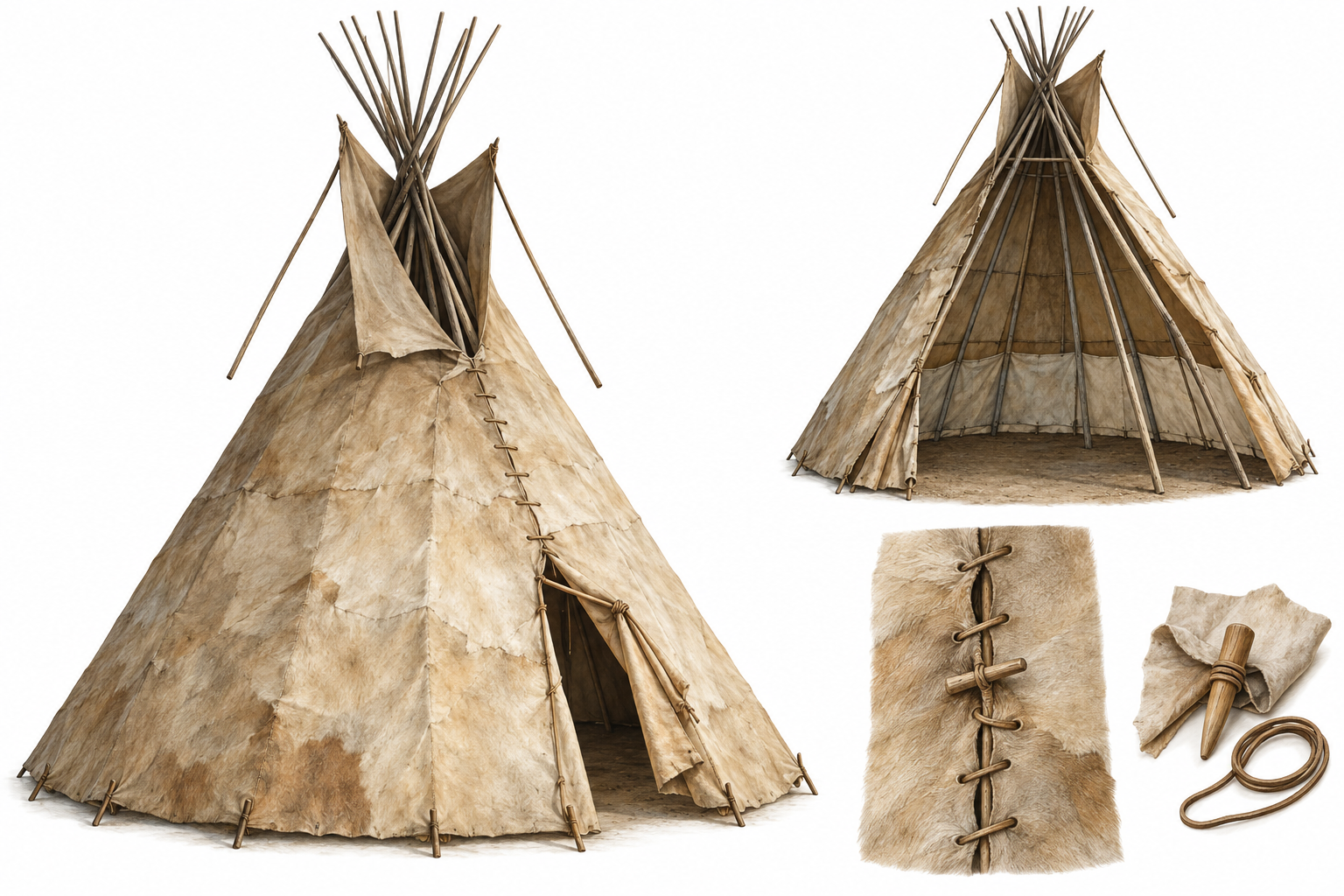
Plains Cree tipi educational reconstruction showing exterior, frame and interior cutaway
Teaching illustration • Plains Cree. Generated reconstruction of a Plains Cree tipi form. The close-up depicts loop-and-wood-pin closure detail, not a sewn seam. Pole arrangement and dimensions are illustrative; cultural teachings are not inferred from the image.

A question to carry
as you read

How can a home be strong, useful and ready to move?

Words along the way

Frame
The connected parts that support a structure.
Covering
The outer material that encloses and shelters a space.
Portable
Designed to be carried or moved.
Plains Cree
The specific Cree cultural and language context of the Wanuskewin example used here.

01 · Begin with place

Begin with a Plains Cree example

At Wanuskewin near Saskatoon, educators share a Plains Cree tipi tradition. Wanuskewin names Elder Mary Lee as the source of the teachings gifted to its program. Starting with a named place and teacher helps us learn accurately. A tipi should never stand in for every First Nation, or for every kind of Indigenous home.

Read the sources: Tipi Walk and Northern Plains Technology

02 · The structure

Two parts, different jobs

A tipi brings a wooden pole frame together with an outer covering. The frame holds the shape; the covering encloses the living space. The Western Development Museum describes historical coverings made from animal hides, often bison. Studying these parts separately helps us see how builders combined materials to meet a household’s needs.

Read the sources: Smarter Science: North Battleford student package

03 · Living inside

Shelter also needs air

Shelter must respond to weather and to the activities inside it. In the museum’s example, flaps near the top allow smoke from an interior fire to escape. This feature makes a useful design question: how can a shelter enclose a space while allowing air to move? Full-size construction and fire use need experienced guidance.

Read the sources: Smarter Science: North Battleford student package

04 · Mobility

A home can travel

Portability is part of a tipi’s design. Taking apart a frame and removing its covering makes movement possible in a way that a fixed wall cannot. The museum also emphasizes women’s work in making, owning and raising historical tipis. Behind the structure are skilled people, careful preparation and knowledge passed between generations.

Read the sources: Smarter Science: North Battleford student package

05 · People and knowledge

Learn with the people who teach it

The NCCIE account of Wanuskewin’s program connects tipi raising with Plains Cree history, worldview and hands-on learning. A diagram can explain a frame, but it cannot teach everything a cultural educator shares. Tipi knowledge is living knowledge. Community teaching, local protocols and permission matter when learning more.

Read the sources: Tipi Raising Program at Wanuskewin Heritage Park

Your turn

A small shelter investigation

  1. Sketch a frame and covering. Label the different jobs they do.
  2. Build two small classroom shelter models using the same materials and height, with different base widths. Keep them unpainted.
  3. Apply the same gentle push in the same place. Repeat and record which model tips first.
  4. Explain your result and one limit: what does this model fail to tell us about a real Plains Cree tipi?

Show what you learned. A labelled drawing, a simple observation table and an explanation linking structure to stability.

Optional screen model · simplified classroom model

Compare base width

Change the base width of an abstract frame. Then apply the same gentle simulated push. This simplified classroom model illustrates one structural variable only; it is not an authentic tipi construction, a prediction about real tipis, or cultural teaching.

Use the arrow keys or move the slider. Frame height and push stay the same.

Abstract frame with adjustable baseA simple triangular frame with a medium base. The frame is upright.
Abstract classroom frame diagram · not a construction plan.

The medium base is ready. Predict what may happen before you apply the push.

What this model leaves out: materials, ground, covering, frame details, weather, people, and the knowledge shared by Plains Cree teachers. For the hands-on activity, use the sources and local teaching context above.

Your note stays on this page. It is not saved or sent. Copy or print it before leaving if you need to keep it.

Optional classroom notesFor teachers: Saskatchewan connections

These are suggested connections to specific outcomes. Use the linked curriculum and the scope notes to plan the rest of the learning.

Grade 3 · Science

SM3.2

Examine how structures function and how strength, stability and balance support that function.

Relevant indicators

  • a Explain what a structure is designed to do.
  • f Compare characteristics of shelters from different places and times.
  • i Plan and build a simple structure to meet agreed criteria.
  • l–m Represent the construction process and evaluate the result.
Classroom activity
After the tipi reading, build two small unpainted pole-and-paper shelter models with the same height and materials but different base widths. Apply an identical gentle push and record the outcome. Compare the model with a documented Plains Cree tipi example.
Evidence of learning
A labelled design, observation table, and explanation connecting a structural choice with stability.
Scope of this connection
Supports a small design investigation. It does not teach authentic tipi construction or cultural teachings. Shelter comparison requires a second documented example, and the full outcome includes other structures, safety and materials investigations.

Suggested connection · Source checked 2026-09-27

Keep exploring

The evidence behind the story

Sources & further reading.

Sources checked 2026-09-27.

  1. Tipi Walk and Northern Plains TechnologyWanuskewin

    Community cultural centre describing its Plains Cree programs and attribution to Elder Mary Lee. Program details can change.

  2. Tipi Raising Program at Wanuskewin Heritage ParkNational Centre for Collaboration in Indigenous Education

    Account featuring Wanuskewin educator Teena Nelson; use as a specific Plains Cree educational example.

  3. Smarter Science: North Battleford student packageWestern Development Museum and Saskatchewan Environmental Society

    Museum teaching resource, tipi section on PDF page 14 (printed page 15). General construction information does not establish one design for every Nation.

Public source review only. No claim of community endorsement. No sacred pole teachings, fixed universal pole count, precise construction plans or full-size fire instructions are reproduced. The model activity is an original classroom investigation.

Illustration note. Teaching illustration • Plains Cree. Generated reconstruction of a Plains Cree tipi form. The close-up depicts loop-and-wood-pin closure detail, not a sewn seam. Pole arrangement and dimensions are illustrative; cultural teachings are not inferred from the image.