
Where did it begin?
Who passed it on?
Scottish roots. Fur-trade journeys. Food in hard times. Follow these connections, alongside Indigenous food knowledge and the family traditions that continue today.
ILLUSTRATED STORIES · FOOD & CULTURE
A small bread.
A living history.
From Scottish hearths through Canada’s fur trade to family tables today. Follow a practical bread through lean times, cultural exchange and the hands that pass it on.
Scroll into the story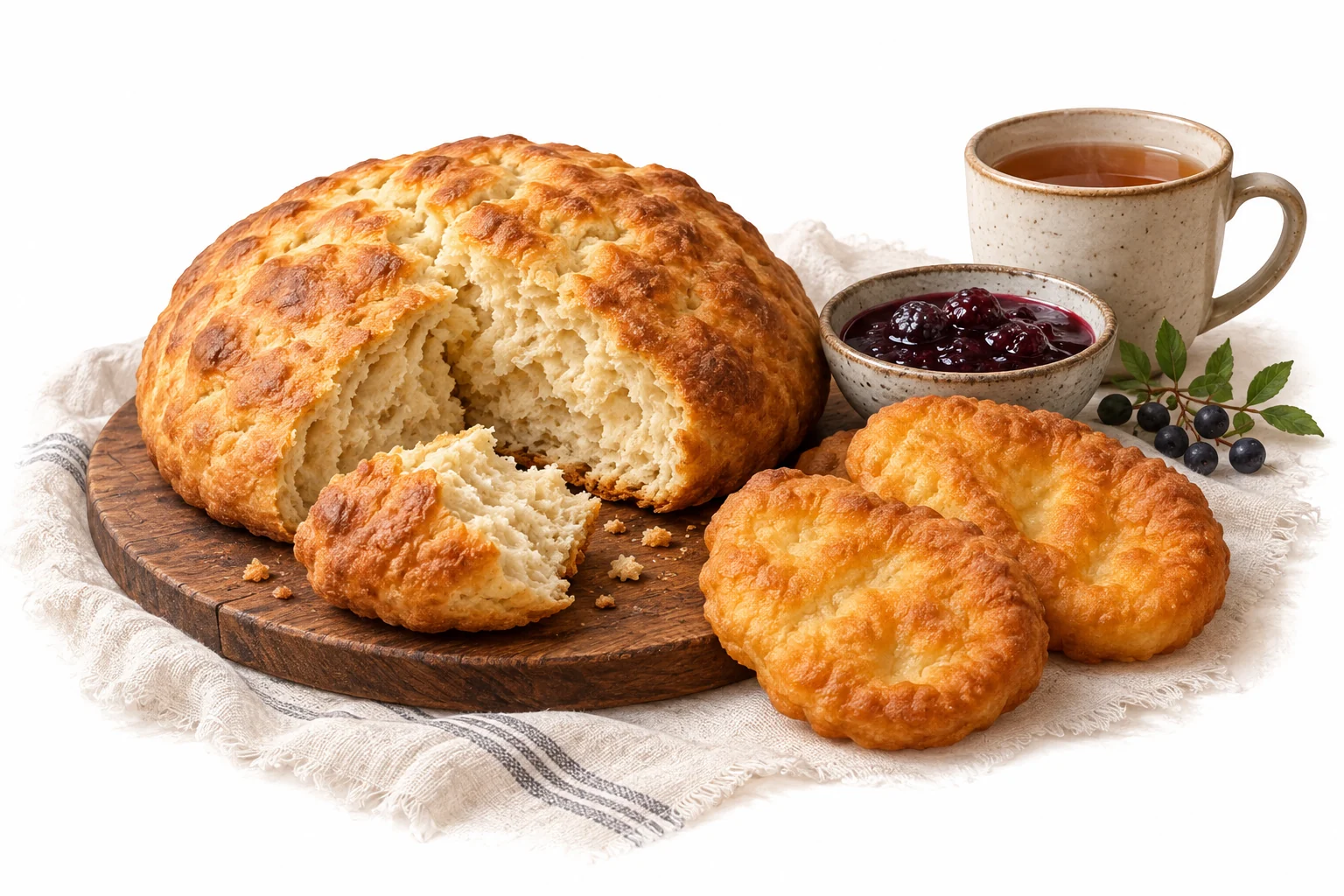
Where did it begin?
Who passed it on?
Scottish roots. Fur-trade journeys. Food in hard times. Follow these connections, alongside Indigenous food knowledge and the family traditions that continue today.
SCOTLAND → CANADA · A FOOD THAT CHANGED
Scottish bannock is an old, flat grain bread. Traders brought this bread tradition into the fur-trade world of what is now Canada. First Nations and Métis cooks adapted flour-based bannock into their own foodways.
Follow three connected stories: an economical Scottish food, a practical bread carried through trade networks, and a food people made during colonial hardship. Later generations gave it their own family and cultural meanings.
We can trace these broad connections. The sources do not identify the first inventor or a single first person-to-person handover. Indigenous plant-food traditions also existed before imported wheat flour.
Dictionaries of the Scots Language ↗ · Parks Canada · Campfire bannock ↗
SCOTLAND · DOCUMENTED BY THE 1500s
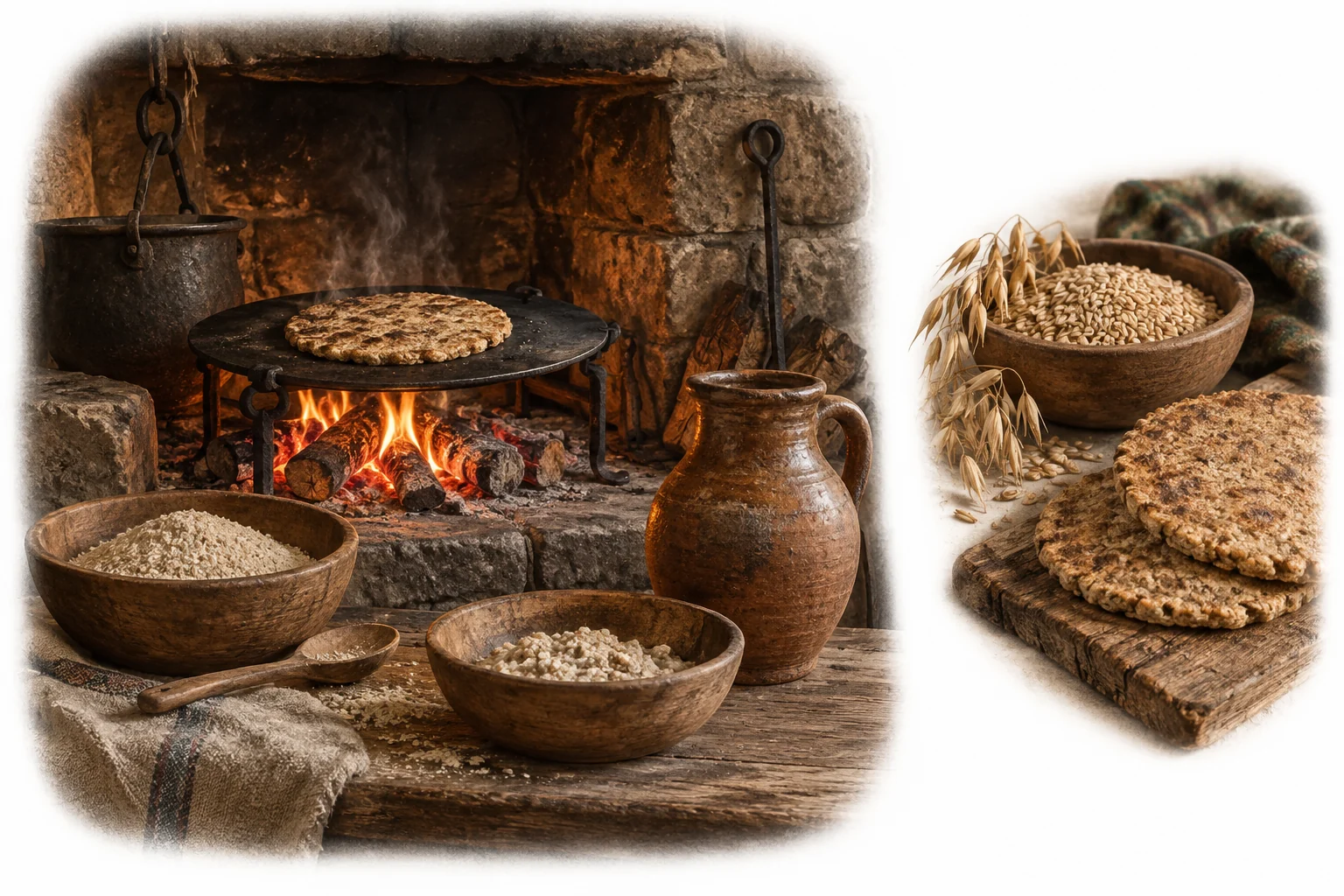
Scottish records use the word bannok by the 1500s. The historical dictionary describes flat, round cakes made with oat, barley or pea meal, cooked on a girdle—a flat cooking plate.
This was a different bread from many fluffy wheat-flour bannocks made in Canada today. The older name covered grain cakes, and recipes changed across places and generations.
A familiar food to carry with you.
A method that could travel.
The dated records establish that bannock existed then. They do not tell us when the first one was invented.
1600s–1800s · MAKING A LITTLE GO FURTHER
Why did this food suit lean times? In Scotland, oats and barley were practical crops, while wheat bread often cost more than ordinary households could afford.
The National Trust for Scotland describes bannocks as filling food for poorer people and labourers. Cooks could stretch the oats with cheaper peasemeal. Flat cakes cooked over the hearth without an oven.
That is not established. The Trust finds bannock cooking in wealthy homes too. It was everyday food that could help stretch limited resources; that does not prove a famine invention.
A PARALLEL THREAD · BEFORE EUROPEAN CONTACT
Indigenous peoples already knew how to harvest, prepare and preserve the foods of their homelands. Those foods differed from place to place.
Ethnobotanist Nancy Turner describes a camas preparation: bulbs were cooked for a long time, dried, then made into cakes or loaves. That is an example of earlier food knowledge—not proof that every Nation made the same bread.
Calling these preparations “bannock” today can blur important differences. A shared shape does not establish that two foods have the same origin.
1760–1821 · CANADA’S FUR-TRADE NETWORKS
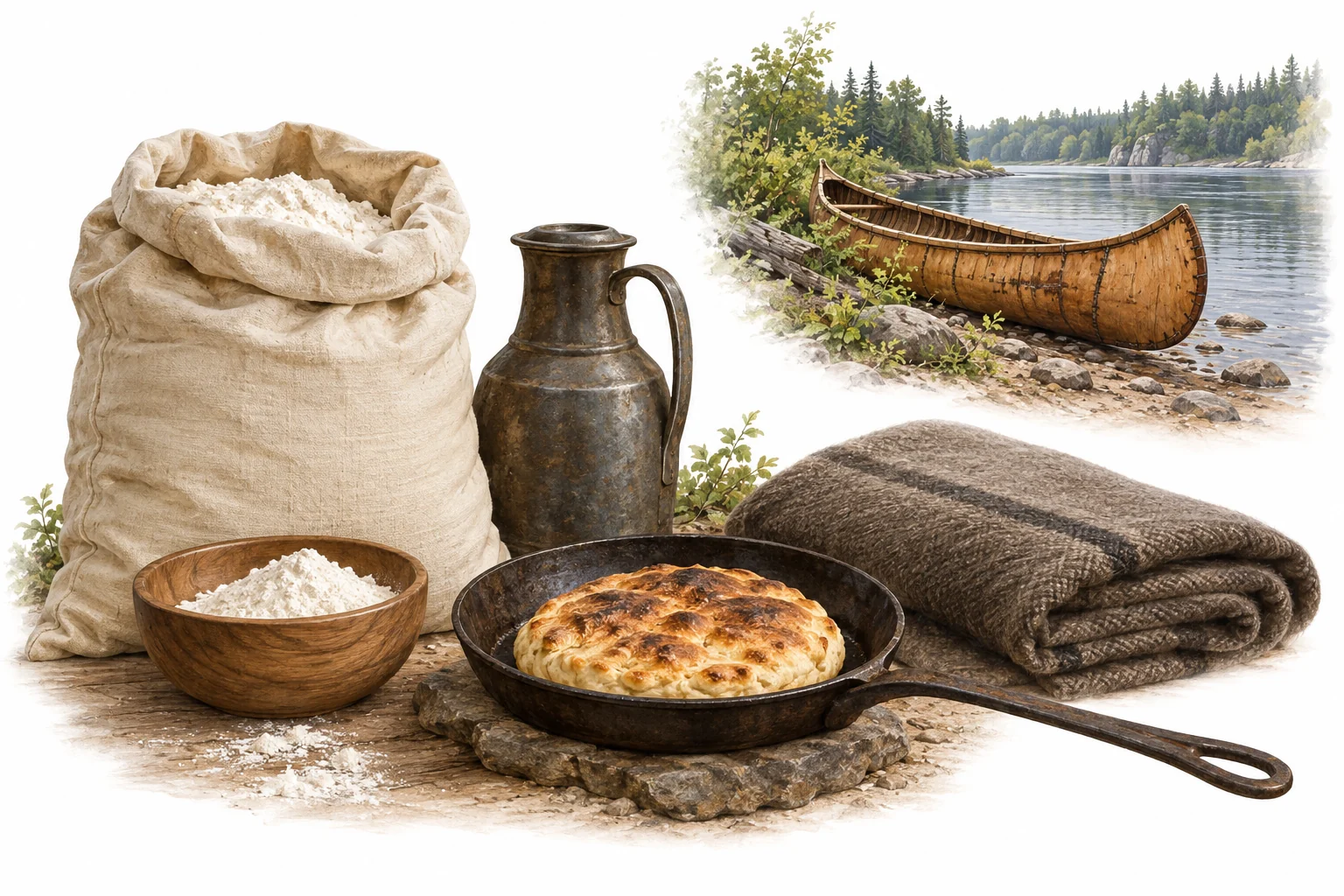
After the British capture of Québec in 1759, Scottish traders expanded their businesses through Montréal. Working with French-speaking voyageurs, they used established routes into the interior. The North West Company competed with the Hudson’s Bay Company.
Parks Canada connects bannock’s arrival with fur traders. A familiar bread travelled with people and provisions; Indigenous and Métis cooks made flour-based versions part of their own food traditions.
Long journeys required dependable food supplies. Bannock was one food in a much larger system: Indigenous and Métis providers supplied fish, game and pemmican, too.
Parks Canada · Fur trade, 1760–1821 ↗ · Parks Canada · Campfire bannock ↗ · Indigenous Peoples Atlas · Métis fur trade ↗
1800s · POSTS, HOUSEHOLDS & RED RIVER
Think of a network of workplaces and families. At Red River, Cree and Ojibway people, Métis communities, Scottish settlers and retired traders lived in an interconnected settlement.
The Métis account in the Indigenous Peoples Atlas describes women providing food for trading posts and maintaining important family ties. Métis workers carried goods by canoe and York boat. These relationships help explain the settings in which ingredients and cooking knowledge could circulate.
Exchange went both ways. At Fort Langley, Indigenous suppliers persuaded traders to buy cranberries, which company workers also ate in bannock.
This explains the connections that made sharing possible. It is not a diary recording exactly who first taught whom to make bannock.
Parks Canada · Red River, 1812–1850 ↗ · Indigenous Peoples Atlas · Métis fur trade ↗ · Parks Canada · Cranberry trade ↗
LATE 1800s · PRAIRIE HUNGER & COLONIAL RATIONS
As Plains bison herds collapsed in the late 1800s, a major food source was lost. The Indigenous Peoples Atlas describes how Canada used that crisis to pressure Indigenous peoples into accepting government settlement policy.
The Canadian Museum of History records starvation tactics under John A. Macdonald to force Indigenous people onto reserves. These conditions changed what families could obtain and cook.
West Coast Bannock’s history describes people adapting flour and lard rations into food during displacement. Here, bannock’s story includes feeding a family with limited supplies under colonial control.
Economical food in Scotland.
Travel food in the fur trade.
Survival food under colonial pressure.
These are different circumstances, not one event. Earlier Scottish bannock and fur-trade use predate this Prairie crisis.
Indigenous Peoples Atlas · Bison hunting ↗ · Canadian Museum of History ↗ · West Coast Bannock · Family history ↗
BY 1900 · A DOCUMENTED CAMP EXAMPLE
The Métis Cookbook and Guide to Healthy Living includes a photograph captioned as a York boat crew baking bannock in camp in 1900. It is a useful dated example—not the first time bannock was made.
The cookbook brings together contributed recipes and food knowledge. Different households make different versions; Métis traditions are not one fixed recipe.
At Rocky Mountain House, Métis interpreters share one bannock recipe with visitors. Parks Canada explicitly says that particular recipe’s origin is unknown.
Métis Centre, National Aboriginal Health Organization ↗ · Parks Canada ↗
TODAY · MANY WAYS TO MAKE IT
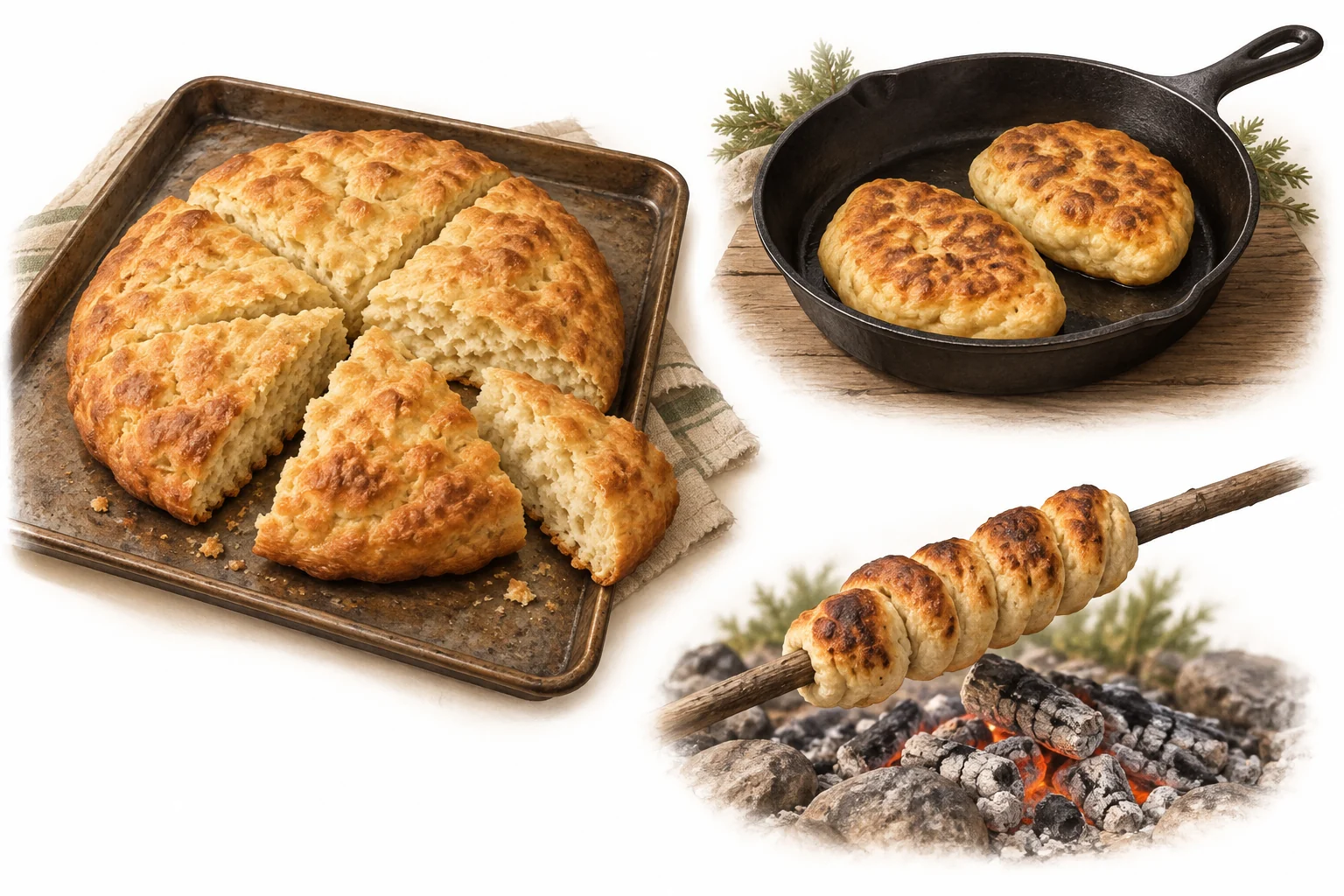
Bannock is not always deep-fried. Recipes may be baked, cooked in a pan, grilled or wrapped around a stick over coals. Ingredients and names vary between families and communities.
At a 2021 SFU workshop, Wet’suwet’en chef Andrew George and Nicola Valley students shared cornbread, standard and whole-wheat versions. Coast Salish ethnobotanist Cease Wyss described a food that changes across generations and cultures.
Look at the three illustrations.
What changes when the cooking surface changes?
LIVING MEMORY · NAMED FAMILY CONNECTIONS
Here we can name a real connection. Chef Steph Baryluk, a Teetl’it Gwich’in chef from Teetl’it Zheh (Fort McPherson), says her mother gave her the recipe. She remembers bannock with soup and on hunting and fishing trips.
Shane M. Chartrand, of Enoch Cree Nation and with a Métis upbringing, describes his grandfather’s galette and his father making it for special occasions.
These are specific family accounts. They show how food becomes part of memory, care and belonging—not a complete family tree for every bannock recipe.
Chef Steph Baryluk ↗ · Shane M. Chartrand with Jennifer Cockrall-King ↗
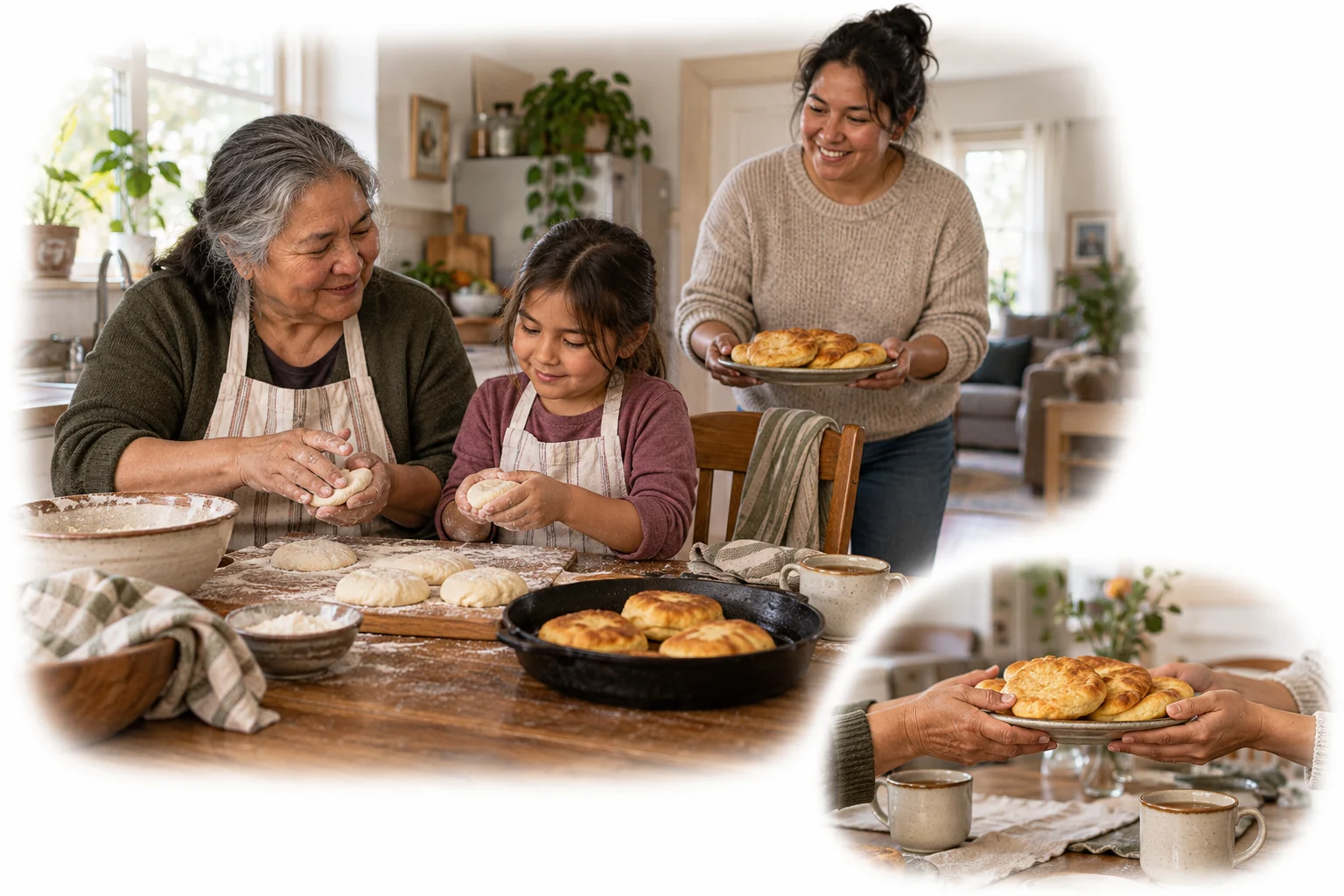
TODAY · FIRST NATIONS, MÉTIS & INUIT EXAMPLES
In the South Qikiqtaaluk learning dialogue on Inuktut Tusaalanga, people compare their bannock and invite each other for tea. The site teaches the word palaugaaq. This is one dialect example, not a name used by all Inuit.
Richard Mark, who is Nisga’a and Gitxsan, describes helping his mother sell bannock from 1997 and developing his own food business. Today his work connects family knowledge with new street-food dishes.
Homes, time on the land, celebrations, language learning and businesses can all give food meaning. First Nations, Métis and Inuit peoples have distinct histories, and not everyone relates to bannock the same way.
CULTURE · MEMORY, CHOICE & CONTINUITY
For many families, bannock connects a meal with the person who taught them, a place they love or a gathering they remember. Culture lives in those relationships as well as in ingredients.
There is also disagreement. Chartrand acknowledges Indigenous people who question bannock’s place in Indigenous cuisine because of colonial history and introduced ingredients, while describing its place in his own family and celebrations.
A food can carry joy and difficult history.
Listen to the people whose story it is.
When you share what you learned, name the cook, Nation or source. Ask about a particular tradition instead of deciding what bannock must mean to everyone.
Chef Steph Baryluk ↗ · Shane M. Chartrand with Jennifer Cockrall-King ↗
YOUR TURN
Which statement best fits the evidence?
Choose a food that matters to you. If someone wants to share, ask:
Draw a small timeline. Mark what you know and what you still wonder about. Ask permission before recording or sharing someone’s story.
Learning aim: Separate evidence from assumptions and explain how food can carry family and cultural meaning.
For younger learners, compare the cooking pictures and draw a food memory. Older learners can compare two linked accounts and explain why they should not be generalized to every Nation.
No cooking is required. If you choose to cook, use a linked recipe, check allergies and arrange adult supervision for heat. Honour community protocols when inviting a guest to share knowledge.
KEEP EXPLORING · ILLUSTRATED STORIES
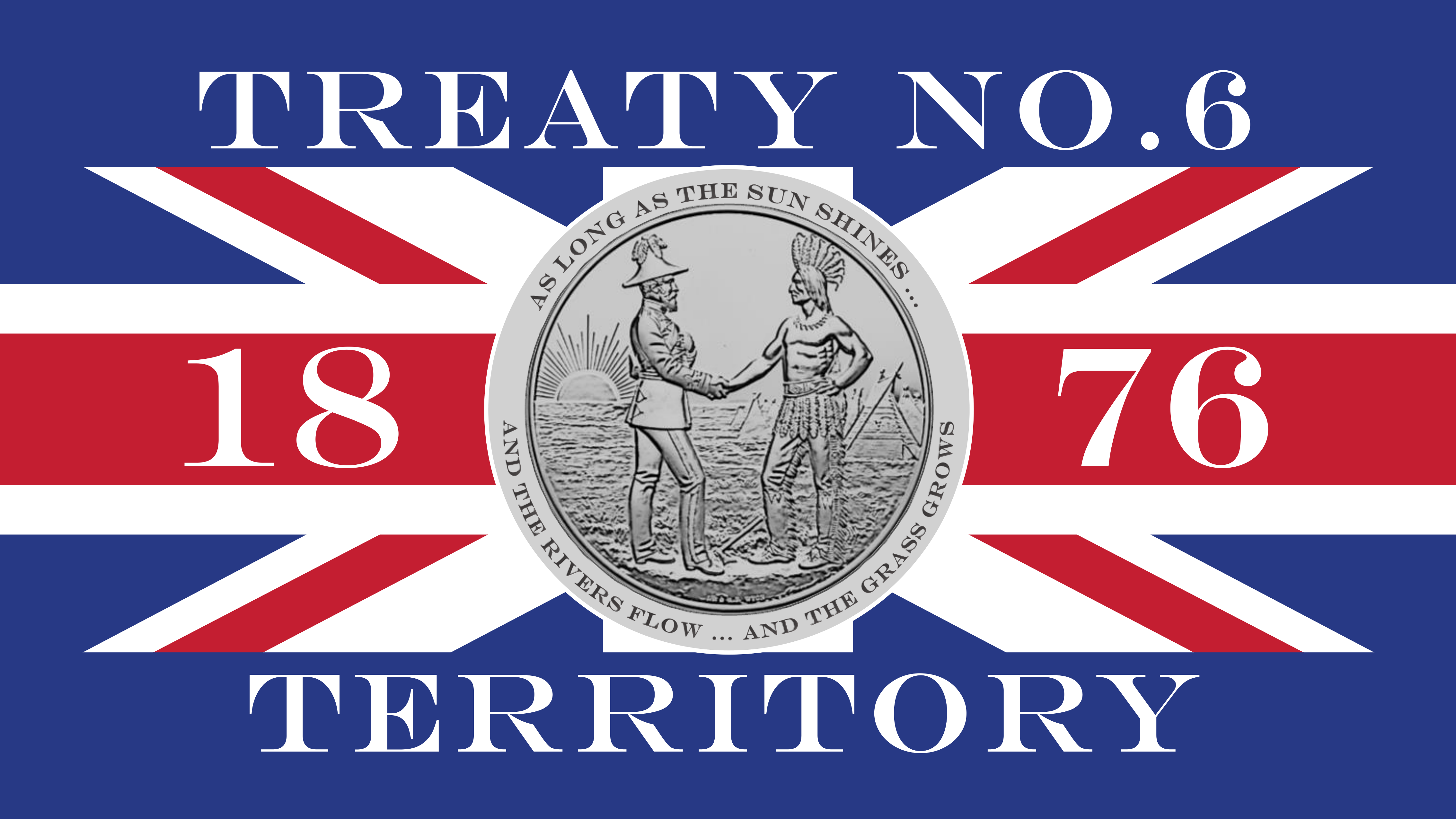 The Treaty Six FlagColours, history & a living relationship →Explore Land Lessons →
Source review: 27 September 2026. An educational synthesis of public records and attributed accounts. This page does not speak on behalf of a Nation or claim community review. Expanded research: Scottish frugality, fur-trade networks and colonial hunger. Broad time periods show context; they are not invention dates.
Images: Five original teaching plates, made with the built-in image-generation tool. The food and historical objects are interpretive. People in the family scene are fictional, not the named cooks or their relatives. No archival photograph is reproduced.
History limits: No first inventor, exact invention date, universal recipe or complete person-to-person chain has been established. The 1900 example is a documented photograph date, not an origin. The Scottish and Indigenous threads are presented together without claiming a single proven descent.
Research and asset record: Read the source notes. Generated images are illustrations, not evidence.